

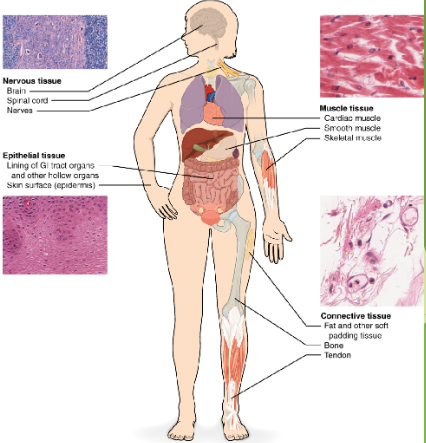
- The human body contains more than 200 types of cells that can all be classified into four types of tissues: epithelial, connective, muscle, and nervous.
- Epithelial tissues act as coverings controlling the movement of materials across the surface.
- Connective tissue integrates the various parts of the body and provides support and protection to organs.
- Muscle tissue allows the body to move.
- Nervous tissues propagate information.
- The study of the shape and arrangement of cells in tissue is called histology. All cells and tissues in the body derive from three germ layers in the embryo:
- Ectoderm
- Mesoderm
- Endoderm.
- Different types of tissues form membranes that enclose organs, provide a friction-free interaction between organs, and keep organs together.
- Epithelial membranes are formed from epithelial tissue attached to a layer of connective tissue.
- There are three types of epithelial membranes:
- Mucous – which contain glands
- Serous – which secrete fluid
- Cutaneous – which makes up the skin